
Greetings, fellow explorers,
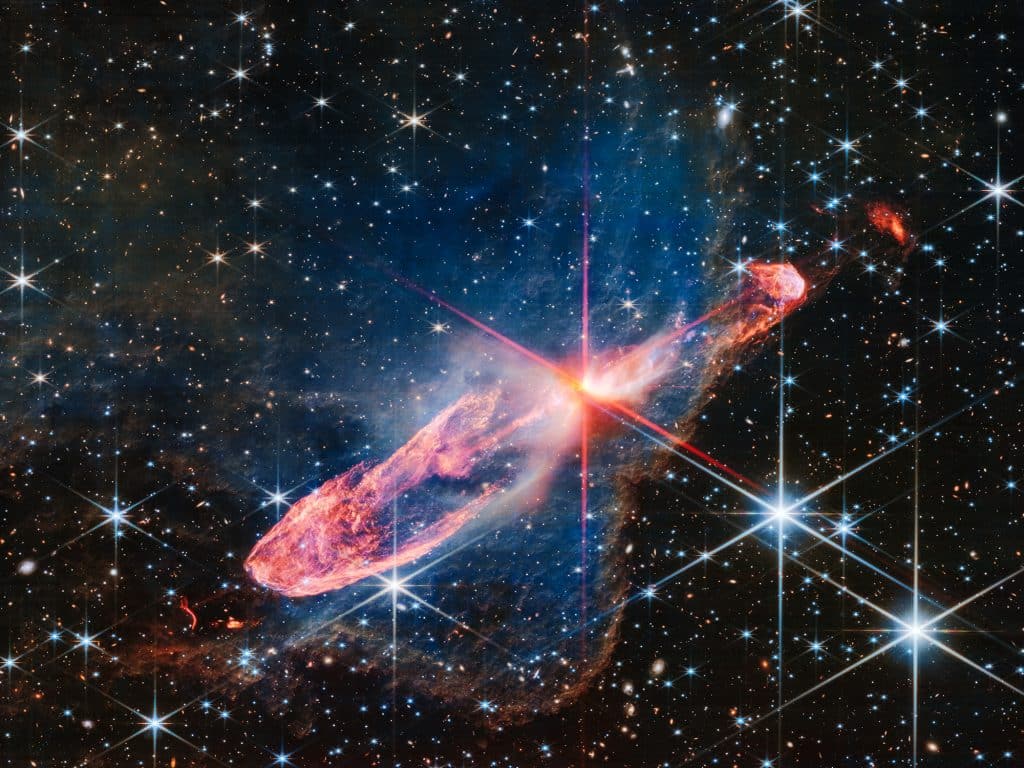
At first glance, this Webb image seems to catch something in flight. Orange clouds stretch across the scene, a brilliant point draws the eye toward the middle, and a pale blue haze softens the surrounding darkness.
We are looking at a place where stars are still taking shape. Herbig-Haro 46/47 gives us a view of that unsettled beginning.
Two stars hidden at the center
About 1,470 light-years away in the constellation Vela, a closely bound pair of young stars is gathering material from its surroundings. The stars are embedded in gas and dust near the bright center of this image.
A surrounding disk supplies material for their growth. Webb does not show the disk directly in this view, but its shadow helps create the dark, cone-shaped areas beside the central source.
I like that this picture asks us to look at the dark regions, too. The brightest parts attract our attention first, while a shadow can tell us about something otherwise hidden.
The clouds record repeated outbursts
The broad orange lobes contain material expelled during the stars’ growth. These outflows have accumulated over thousands of years. Later ejections catch up with earlier material, changing the surrounding shapes.
The bright spikes around the center have a different origin: they are diffraction features produced by the telescope. They should not be confused with the physical jets and clouds extending through the scene.
That distinction gives you a useful way to explore the photograph. Begin at the center, then follow the irregular clouds outward rather than the perfectly straight spikes.
A view through the blue haze
The soft blue region is a nebula of gas and dust. In Webb’s near-infrared view, its layers appear partly transparent, revealing stars and distant galaxies beyond them.
The published image combines filtered observations from NIRCam. Visible colors have been assigned to the infrared data, making differences between those measurements readable to our eyes.
There is a pleasing tension between the force suggested by the orange outflows and the gentleness of that blue cloud. Your eye can follow the main structure across the frame, then wander into the smaller points scattered around it.
Room to keep looking
This is an image I would give some breathing room on a wall. Its wide composition invites you to step back, while the fine detail rewards a closer look.
Explore our Herbig-Haro 46/47 print to find a presentation for your space. The next time you look at it, try beginning with the shadows.
Clear skies,
D.R. Skywalker
Image credit: NASA, ESA, CSA. Image processing: Joseph DePasquale (STScI), Anton Koekemoer (STScI).
Sources: NASA’s account of Webb’s observations; NIRCam image details and credits.