
Greetings, fellow explorers,
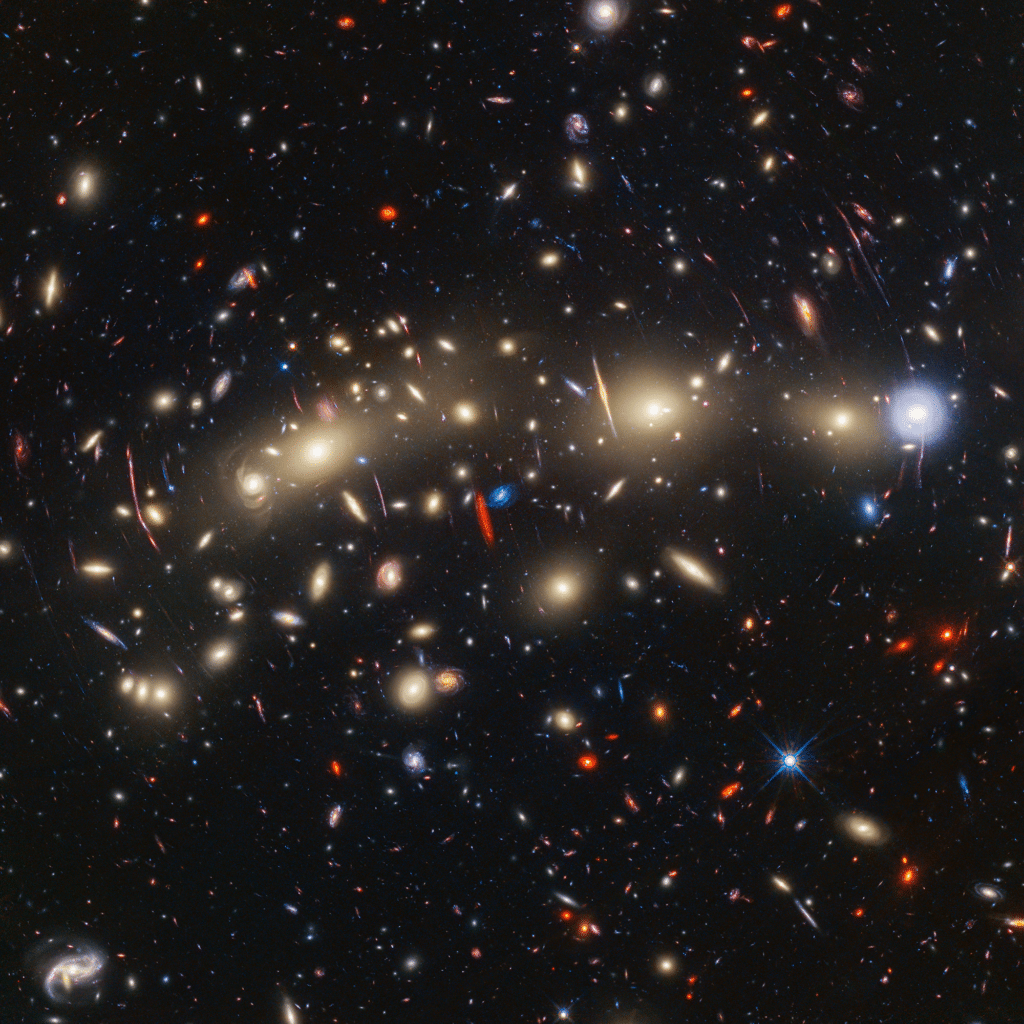
Some space photographs give us a single shape to recognize. This one keeps the eye moving. Small spirals, glowing ovals, red specks, and narrow arcs fill the darkness, each offering somewhere else to look.
The field around MACS0416 invites a question: how much can be happening in one small patch of sky?
A gathering of galaxies
MACS0416 lies about 4.3 billion light-years from Earth. It consists of two galaxy clusters in the process of colliding and eventually becoming one larger cluster.
The image brings together observations from Hubble and Webb. Hubble contributes visible-light detail, while Webb extends the view into the infrared. Their combined observations reveal a wider range of objects than either view provides alone.
I find that partnership especially appealing. Looking carefully can mean returning to the same subject with a different instrument and finding something you could not see before.
Why some galaxies look stretched
Look among the brighter galaxies for thin curves and elongated streaks. The cluster’s gravity bends the light from objects behind it, magnifying and distorting their appearance. Astronomers call this gravitational lensing.
That effect turns the cluster into a natural aid for observing more distant objects. A stretched image can carry information from a galaxy much farther away than the cluster itself.
Try imagining depth instead of a flat field. Some objects are nearer, others lie far behind, and the light reaching us has followed paths shaped by the material in between.
Color offers clues
In this composite, shorter wavelengths are generally represented by blue, longer wavelengths by red, and intermediate wavelengths by green.
The bluer galaxies tend to be relatively nearby and can show strong star formation. Redder galaxies are often more distant, although dust can also redden their light. Color is a clue that needs interpretation, rather than a simple distance label.
It is tempting to take in the whole image as a pattern. Choose one small area instead. Compare a rounded glow with a thin arc, or a faint red point with a clearer spiral. The scene becomes easier to explore when you stop trying to see everything at once.
A photograph to return to
On a wall, this view offers the pleasure of discovering another detail each time you pass. It would suit a place where you can stand close enough to examine the smaller shapes.
Explore our MACS0416 Hubble and Webb print for the available formats and sizes. There is plenty here to keep a curious eye occupied.
Clear skies,
D.R. Skywalker
Image credit: NASA, ESA, CSA, STScI, Jose Diego (IFCA), Jordan D’Silva (UWA), Anton Koekemoer (STScI), Jake Summers (ASU), Rogier Windhorst (ASU), Haojing Yan (University of Missouri). Image processing: Joseph DePasquale (STScI).
Sources: NASA’s account of the combined Hubble and Webb observations; MACS0416 image details and credits.