
Greetings, fellow explorers,
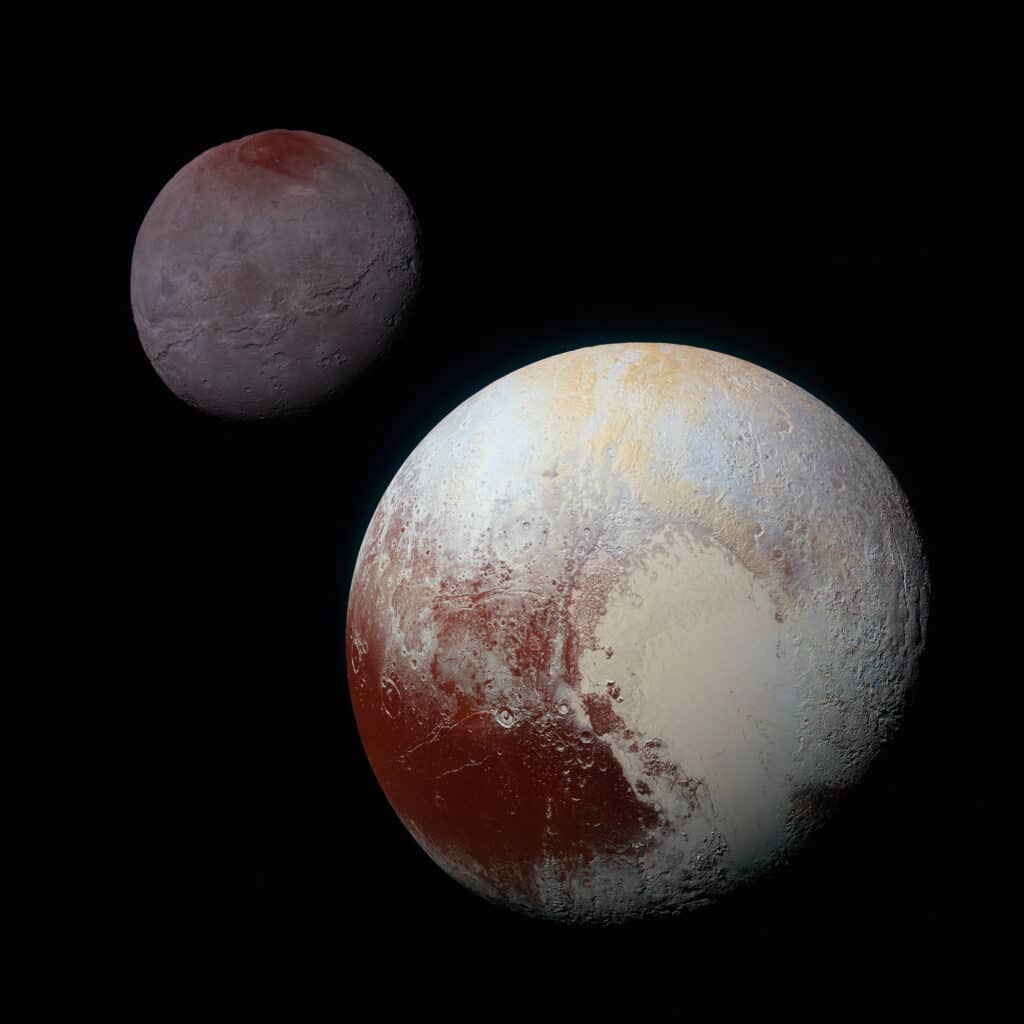
A portrait of two worlds encourages a particular kind of looking. The eye moves back and forth, finding a shared feature, then a difference. With Pluto and Charon, that comparison becomes the heart of the image.
I like how much individuality is visible in this pair. They share the frame, but neither feels like a smaller or larger version of the other.
A close encounter in 2015
NASA’s New Horizons spacecraft gathered the observations during its passage through the Pluto system on July 14, 2015. This composite places Charon at upper left and Pluto at lower right.
The image combines blue, red, and infrared observations from the spacecraft’s Ralph/Multispectral Visual Imaging Camera, known as MVIC. Its enhanced colors make differences in surface properties easier to compare.
For a viewer, that means the picture offers more than an attractive pairing. It has been prepared to help us notice distinctions that might otherwise be less obvious.
Comparing like with like
The color and brightness of both worlds were processed in the same way. That treatment highlights their differences while also showing a resemblance between the reddish terrain near Charon’s pole and reddish regions around Pluto’s equator.
Their relative sizes are approximately correct in this composition, but the gap between them does not represent their true separation. This is an assembled comparison, rather than a single photograph showing their arrangement to scale.
I find that useful to know before settling into the picture. We can appreciate the composition while understanding what it was designed to show. A thoughtful comparison sometimes requires bringing its subjects closer together on the page.
Two places to begin looking
Try choosing one feature on Pluto, then moving to Charon to see what catches your eye there. The act of comparison slows you down. Instead of taking in two circles against black space, you begin noticing how differently each surface is patterned.
Our Pluto and Charon — New Horizons print gives that comparison a place in your home or workspace.
For me, it captures one of the pleasures of exploration: reaching a subject closely enough that its individuality becomes visible. Names on a chart become places with features to study.
Let your attention move between them once more before you leave the image. Each world gives you a different reason to look.
Clear skies,
D.R. Skywalker
Image credit: NASA/JHUAPL/SwRI.
Sources: NASA — Charon and Pluto: Strikingly Different Worlds.