
Greetings, fellow explorers,
Jupiter is familiar enough that we arrive with expectations. We look for bands, storms, and a large globe dominating its surroundings. Webb gives us another way to see that familiar subject, drawing attention to details our eyes would otherwise miss.
In this wide-field view, I find myself looking beyond the bright planet. The surrounding darkness contains part of the story too.
Looking beyond visible light
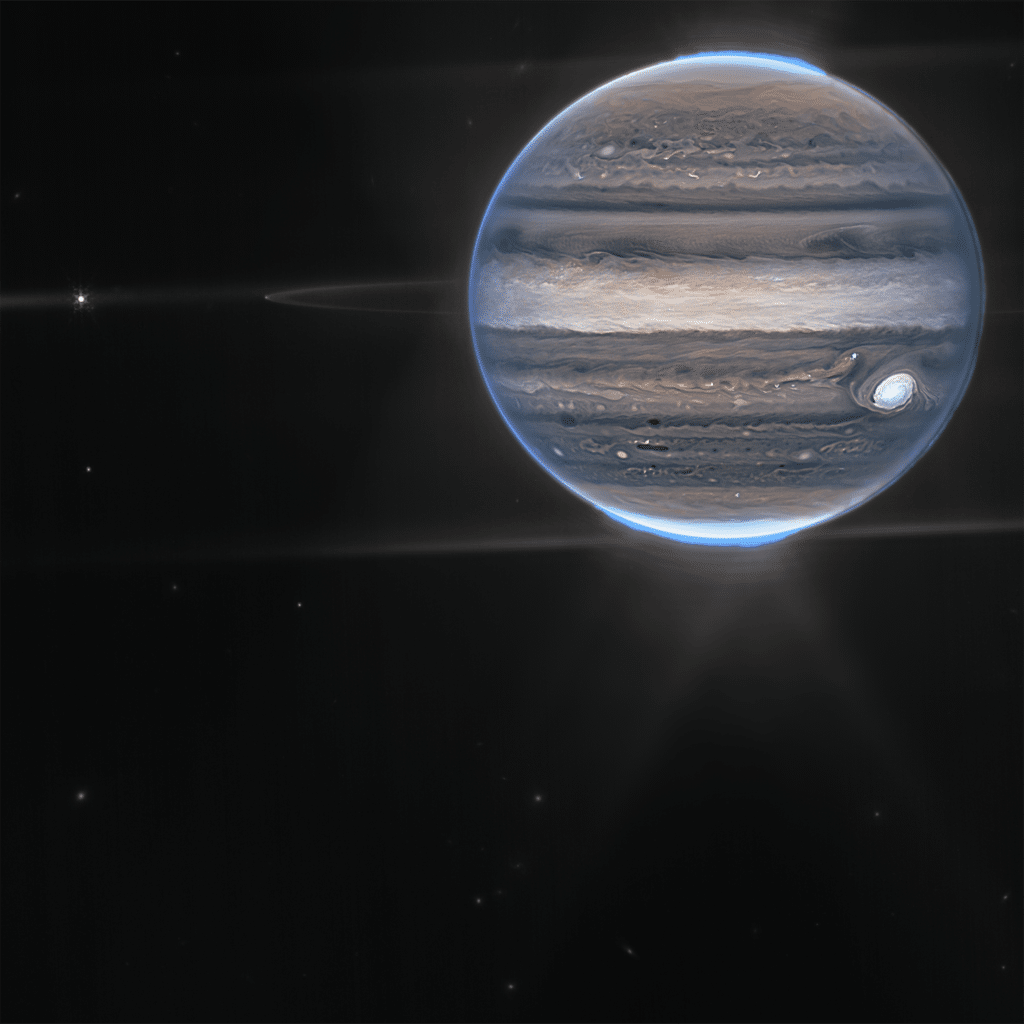
Webb’s Near-Infrared Camera, or NIRCam, collected the observations for this composite on July 27, 2022. Infrared wavelengths are mapped into visible colors so that we can examine the recorded structures.
The result is a scientific view rather than a reproduction of Jupiter’s naked-eye colors. Auroras, clouds, and atmospheric hazes appear according to how they register in the selected infrared filters.
Knowing this gives color a different role in the picture. It helps us read the observations. A familiar planet becomes an opportunity to ask what changes when we use a different instrument to look at it.
A giant with faint companions
The wide field includes Jupiter’s rings and two small moons, Amalthea and Adrastea. The rings are about a million times fainter than the planet. Some fuzzy background objects are likely distant galaxies.
That range of brightness is part of what makes the image compelling. The planet is the obvious center of attention, but the frame rewards a slower inspection.
Try letting your eye move away from the disk before returning to it. The small companions and faint structures make Jupiter feel less isolated. We are looking at a planet within its local surroundings, with still more distant objects behind it.
A view worth studying up close
There is pleasure in recognizing a subject, and another kind of pleasure in realizing you have not seen all of it. This image offers both. Its overall shape is immediately legible, while the finer details ask for more time.
Our Jupiter Showcases Auroras and Hazes — Webb print brings this infrared perspective into the collection.
I like it as a reminder to return to familiar things with a new question. Sometimes a different view adds more than a new subject would.
Start with Jupiter, then explore the space around it. The brightest object is only the beginning.
Clear skies,
D.R. Skywalker
Image credit: NASA, ESA, CSA, Jupiter ERS Team; image processing by Ricardo Hueso (UPV/EHU) and Judy Schmidt.
Sources: NASA — Webb’s Jupiter Images Showcase Auroras, Hazes; ESA/Webb — NIRCam Widefield View.