
Greetings, fellow explorers,
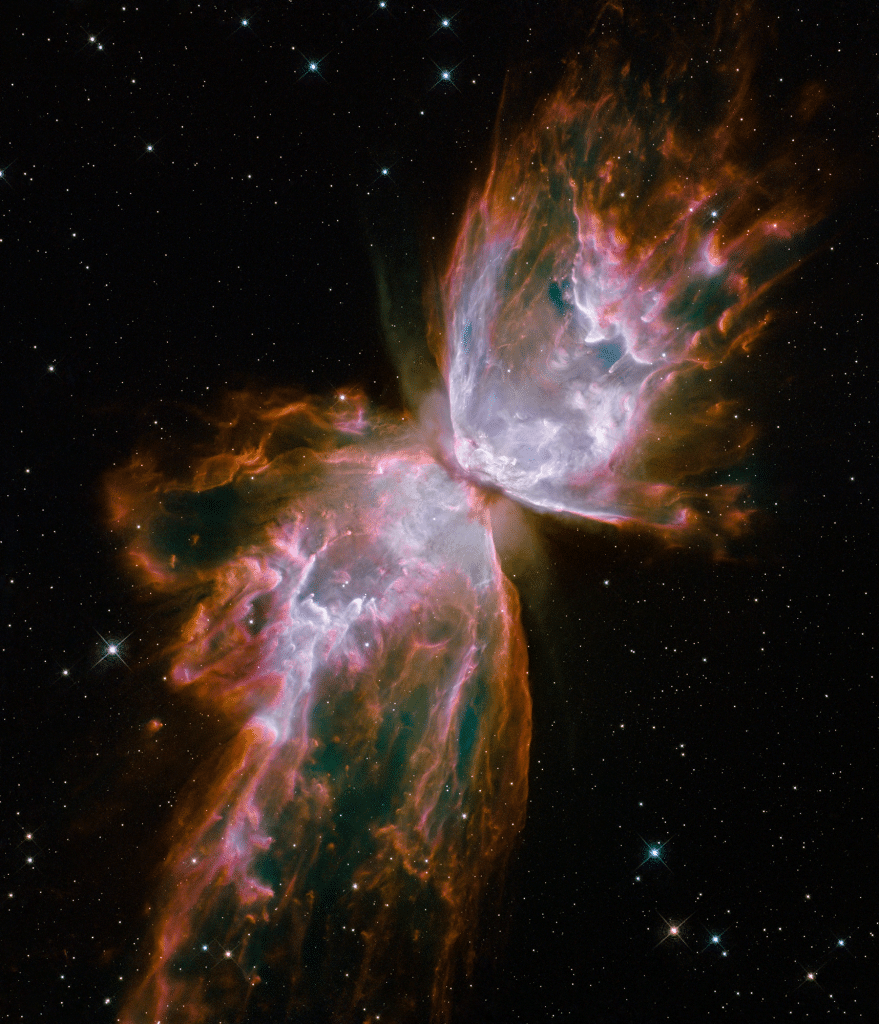
The Butterfly Nebula invites a gentle comparison. Its broad wings and narrow middle seem familiar enough to belong to something we could hold in our hands. The name gives the eye a pattern to recognize before the scale of the scene becomes clear.
What interests me is how that first impression changes when we learn what those wings contain.
A star’s outer layers
Catalogued as NGC 6302, the Butterfly Nebula lies approximately 3,800 light-years away in Scorpius. It is a planetary nebula, formed from material expelled by an aging star.
The wing-like lobes extend more than two light-years. Gas within them is heated to nearly 20,000 degrees Celsius, and some of it travels at more than 950,000 kilometers per hour.
Those figures are difficult to attach to something that looks so delicate. I find it useful to pause on that mismatch. The photograph lets us study a form quietly, even when the processes that produced it were anything but quiet.
The hidden center
A thick, dusty ring obscures the central star in this view. The dark waist between the lobes marks material that helped channel the outflow into the nebula’s distinctive bipolar shape.
Hubble’s Wide Field Camera 3 observed this scene on July 27, 2009, after astronauts installed the instrument that May. The image combines observations through filters that isolate light from different elements.
Start at the dark middle and trace the expanding shapes outward. Some edges appear sharply defined; other areas look softer and more tangled. The symmetry makes a first impression, but the differences reward a second look.
A picture that changes with the story
I like images that give us a reason to revise our first impression. Here, the butterfly remains a useful way into the picture, even after we understand that its wings are vast structures of gas.
Our Butterfly Nebula — Hubble print gives that contrast a place on your wall. It can be enjoyed for its shape and color, or used as the beginning of a conversation about how stars change.
The next time you see it, try following just one edge from the center outward. A familiar outline contains a surprising amount of complexity.
Clear skies,
D.R. Skywalker
Image credit: NASA, ESA and the Hubble SM4 ERO Team.
Sources: ESA/Hubble — Butterfly Nebula, NGC 6302.