
Greetings, fellow explorers,
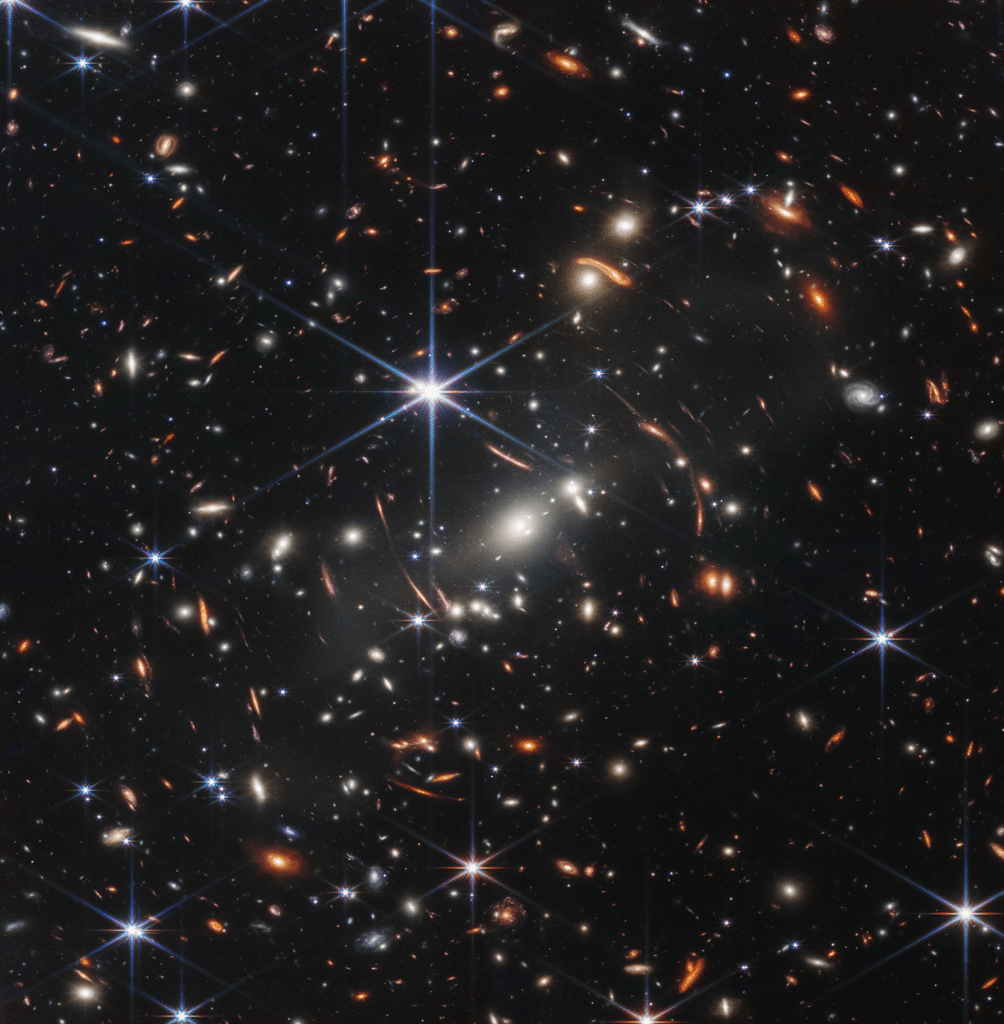
Today, we delve into one of the most groundbreaking and awe-inspiring achievements in modern astronomy—Webb’s First Deep Field. Captured by the James Webb Space Telescope (JWST) using its Near Infrared Camera (NIRCam), this image reveals the universe in stunning detail, far beyond what we have ever seen before.
James Webb’s First Deep Field
Webb’s First Deep Field focuses on a tiny patch of sky in the constellation Volans, showing a galaxy cluster called SMACS 0723. But what makes this image extraordinary is not just the galaxies within the cluster but the countless other galaxies that appear behind it. Thanks to the gravitational lensing effect of the galaxy cluster, light from even more distant galaxies is magnified, allowing us to peer deeper into the universe than ever before.
This image, taken over just 12.5 hours, surpasses the depth of the Hubble Ultra Deep Field, which required weeks of exposure time. The level of detail and the sheer number of galaxies visible in this small region of the sky is staggering. Webb’s First Deep Field reveals galaxies as they were over 13 billion years ago, shortly after the Big Bang.
One of the most fascinating aspects of this image is the presence of galaxies with redshift values that indicate they are among the oldest known in the universe. These ancient galaxies, which appear as tiny red dots in the image, are some of the earliest building blocks of the universe, offering us a glimpse into the epoch of reionization when the first galaxies and stars were forming.
Here’s an intriguing tidbit: The gravitational lensing effect seen in this image creates distorted, arc-like shapes of the background galaxies. These “Einstein rings” are not just visually striking but also provide astronomers with a powerful tool to study dark matter and the distribution of mass within galaxy clusters.
Webb’s First Deep Field is a testament to the incredible capabilities of the James Webb Space Telescope. With its advanced infrared imaging, JWST can see through cosmic dust and reveal structures that were previously hidden, allowing us to explore the universe in unprecedented detail. This image is just the beginning of what promises to be a new era of discovery.
As you gaze upon Webb’s First Deep Field, consider the enormity of the universe and the incredible journey that light has taken to reach us. Each speck of light in this image represents a galaxy, containing billions of stars, planets, and untold mysteries. The universe is vast, ancient, and full of wonders yet to be discovered.
In our next post, we will continue our exploration of the cosmos, diving into another celestial marvel. Until then, keep your curiosity alive and continue to explore the wonders of the universe.
Clear skies,
R. Skywalker
Capture the unprecedented beauty of Webb’s First Deep Field with exhibition-quality prints. Available on premium paper and canvas, each piece showcases the detailed and breathtaking view of the universe as revealed by the James Webb Space Telescope. Visit our shop to explore the collection.
Credits
Image
NASA, ESA, CSA, STScI