
Greetings, fellow explorers,
Some images from space feel vast and distant. Others feel strangely intimate, as though we are looking into a place where creation is still unfolding.
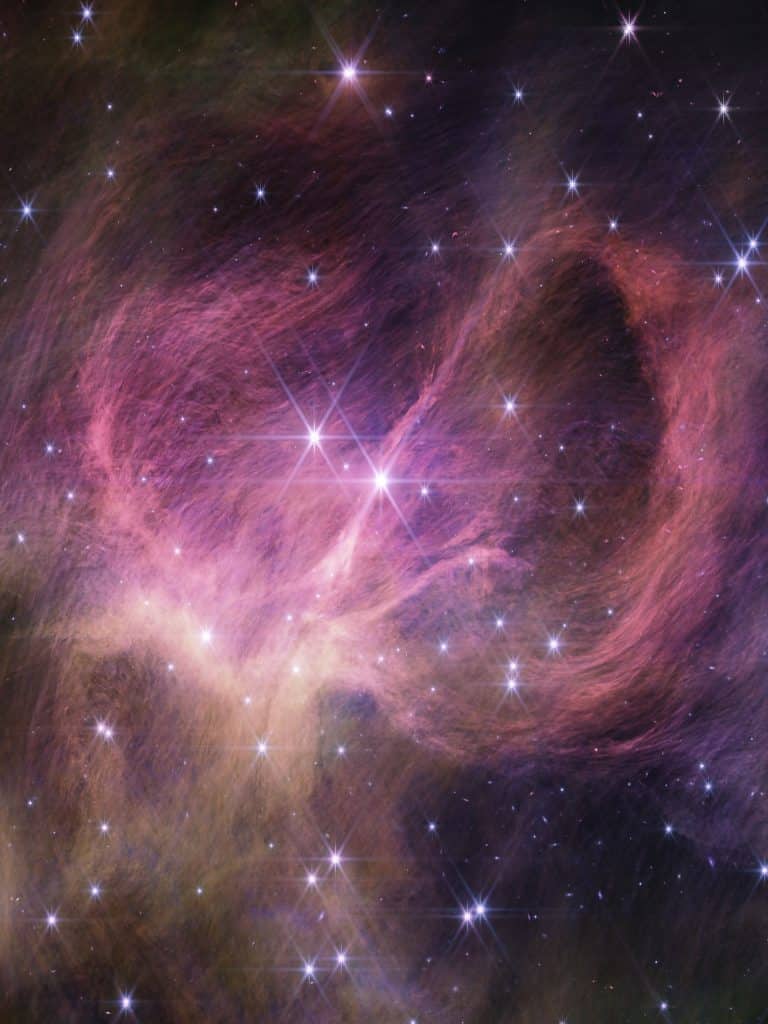
The James Webb Space Telescope’s image of IC 348 offers exactly that kind of view. Located in the constellation Perseus, IC 348 is a young star cluster wrapped in delicate strands of gas and dust, glowing in Webb’s infrared vision. The result is an image filled with soft color, layered texture, and scattered points of light that seem to emerge from a cosmic veil. NASA describes it as the central portion of the cluster, captured by Webb’s Near-Infrared Camera, or NIRCam.
What makes IC 348 especially fascinating is that it is not only beautiful. It is also scientifically important. Astronomers used Webb to search this cluster for tiny free-floating brown dwarfs — objects too small to become full stars, but larger than most planets. In this region, researchers identified three brown dwarfs with masses below eight times Jupiter’s mass, including one estimated at only three to four times Jupiter’s mass. That makes it one of the smallest known objects formed in a star-like way.
There is something captivating about that idea. IC 348 is not simply a field of stars. It is a place where nature seems to blur the lines between stars and planets, between what fully forms and what almost does. It reminds us that the universe does not always fit neatly into categories. Even in a single image, Webb shows us both beauty and mystery — glowing dust, newborn stars, and objects that challenge how astronomers think about formation itself.
Visually, IC 348 has a different mood from some of Webb’s more dramatic deep-space images. It is less about explosive power and more about quiet emergence. Wispy filaments sweep across the scene like brushstrokes, while the stars shine through in varying brightness and color. It feels alive, but not chaotic — more like a hidden nursery tucked inside the dark. That softer, layered quality is part of what makes it so compelling as a piece of space art.
For collectors, dreamers, and anyone drawn to the wonder of the cosmos, IC 348 offers more than a scientific snapshot. It offers a glimpse into beginnings. It is a reminder that the universe is still creating, still shaping, still surprising us with forms we are only beginning to understand.
In future posts, we’ll continue exploring the images and stories that bring the universe closer to home. Until then, keep looking up and keep your sense of wonder alive.
Clear skies,
D.R. Skywalker
https://spaceartstudio.com/product/ic-348-nircam-image-james-webb-space-telescope-image/
Image Credit: NASA, ESA, CSA, STScI, Kevin Luhman (PSU), Catarina Alves de Oliveira (ESA)